As of October 18, 2013, Pie and Beer has moved!

Click here to go to the new address, or stay here to read posts from the archives.


Sunday, January 07, 2007

Birthday Salmon

Last week was Mr. Chalmers's birthday, but as he does every year he spent it at a conference. When he comes home today we'll have chocolate cupcakes with chocolate frosting—I think he asked for that wacky combination a couple months ago, and anyway he's right that I never make chocolate desserts, so I thought this was a good excuse. (It's all fruit and spice around here.) I don't know much about chocolate cake or frosting, so I posted a query on Chowhound asking for the best chocolate frosting recipes ever. It paid off: this is the chocolate frosting I'll use till my dying day (although I have enough left over to last that long in the freezer, assuming it freezes okay—or, rather, thaws okay). It's very chocolatey, not too sweet, not grainy, not greasy or fatty-tasting like a buttercream can be, and not as dense as a ganache. It spreads easily, and stiffens as it cools on the cake but does not become crusty like a lot of frostings do. In short, it's perfect. I used a random combination of Ghirardelli milk and semisweet chocolates, plus a little over half a pound of good bittersweet. Here's a shortened version of the recipe:

Chocolate sour cream frosting: Melt about 2 pounds chocolate in a double boiler. Remove from the heat and stir in about 3 cups sour cream and 1/2 teaspoon vanilla extract. Frost cake immediately. Makes about 4 cups.

The cake recipe I used happened to be very good too. Very rich and moist, but light and tender. I used that crazy "Special Dark" Dutch-process Hershey's cocoa powder, and the cakes are pitch black. (Other things I've made with that stuff look too weird and dark, not like other Dutch-process cocoa powder I've used, so I'm glad to have been able to use up 3/4 cup of it this morning.) This recipe made twenty-four cupcakes.

A lot of my pictures these days are taken when it's still dark out; hence the bad lighting.

The gravlax is ready! Following (sort of) Ruhlman and Polcyn in Charcuterie, I cured a pretty piece of wild king salmon from Your Dekalb Farmer's Market in brown sugar, salt, a little black pepper, and lots of dill—wrapped in plastic and weighted down—for a little over two days. I know approximately as much about gravlax as I do about chocolate cake, but the little schnibbley I took from the thin end seemed a bit too hard and maybe too sweet. It's probably just that I expect it to taste like smoked salmon—lox—a completely different thing altogether. (The Chalmerses will make lox as soon as we have the smokehouse built. I've bookmarked something called KountryLife.com, so you know I'm serious. I did not, however, bookmark EndTimesReport.com.) I think it'll be nice with the mustard sauce I threw together this morning, and thin slices of pumpernickel, topped with strips of the skin that have been crisped and blackened in a hot skillet.

Layer of brown sugar, salt, and pepper mixture, then the salmon fillet skin side down, then more sugar mixture, then dill.

Salmon wrapped tightly in plastic. The juices will run out into the pan, in effect becoming a brine.

Weighted down with cans in the fridge, where the salmon spent about two days.

Salmon unwrapped, rinsed off, and patted dry.


Mustard sauce for gravlax: Whisk together about 1/3 cup crème fraîche, 1 tablespoon grainy mustard, and a touch of honey to taste. Stir in about 1 tablespoon snipped fresh dill.

Yes, I'd had breakfast and made cupcakes and mustard sauce and finished the gravlax before it was time to feed the dogs at 6 this morning. The bug is up and ready to play by 3:30 lately, whether she goes to bed at 4:30 or 7 the night before. These last few dark mornings have given me time to think about how to re-broach the subject of the floodlight the neighbors have decided to point directly at our house and leave on twenty-four hours a day. When I asked about it last week, the guy said it was for security purposes. Is there any specific threat that he's concerned about? Yes, he said, as a matter of fact there are black people who live in trailers and small houses down the road, and they deal drugs on the corner, and sometimes they ride by on four-wheelers.

Happy birthday, sweetheart, and welcome home.

Saturday, January 06, 2007

Back in Ghee

I've been holding off on cooking Indian food lately because I didn't have any ghee in the pantry, but now I'm good to go. The other day I made a good-sized batch of my own in the old slow cooker. This may be my one great contribution to the world of food: slow-cooker ghee. It's in the little book I wrote, but basically all you do is
Ghee: Put 3 to 4 pounds unsalted butter (frozen is fine) in a 6-quart slow cooker, turn it on low or high (it really doesn't matter, I've found), cover with the lid slightly askew, and don't touch it or jostle the pot for many hours, until the foam on the top is a bit crusty and browned around the edges and it smells good. Skim the foam off and save it for spreading on fresh bread. Gently pour the clear ghee into a jar, leaving the solids on the bottom behind (discard those solids). This makes whatever this jar is—1 quart, I guess.
Don't imagine that melted or even clarified butter is the same as ghee. It's not even close. Ghee has a distinctive flavor that can only come from long, slow cooking. Usually this is done in a low oven or on the stovetop, which is so tedious and, frankly, wasteful. It's much easier in the slow cooker. Just buy a bunch of butter when it's on sale, and freeze it until you want to make ghee. For some of the really delicious Indian sweets you need a lot of ghee, so it's nice to have a lot on hand without having to buy expensive ready-made ghee.

Tuesday, January 02, 2007

Eat Poor

Happy 2007! We had the usual Southern New Year's Day food around here, if only because Ingles was pushing the collards and black-eyed peas so hard. (Unfortunately, the collards I tried to grow in the fall were too stunted and scrawny to bother picking; turns out that our soil's nitrogen content, on a scale of zero to 6, is zero. Will try again next year.)

How do you make hoppin' john? This is how I've been making it since I lived in Queens and ate poor all year round, but other peoples' versions are different. Mine is much more flavorful than others I've tasted, but it looks kind of awful.

Cornbread muffin, hoppin' john, and collard greens. Vinegary hot sauce.
Hoppin' john: Sorry these measurements are so vague; this is just for technique, and for comparison's sake if anybody cares. Rinse and pick through 1/2 pound dried black-eyed peas. Put in a pot with water to cover by several inches; bring to a boil, cover, and let soak for 1 hour. Drain and rinse again. In a large pot, cook about 6 strips bacon until crisp; remove the bacon from the pot, set aside, and pour off all but 1 tablespoon of the fat. Add 1/2 chopped onion to the fat and cook over medium heat until softened. Add the black-eyed peas and enough water to cover by about 2 inches. Bring to a boil, then lower the heat to maintain a simmer and cook until almost tender. Dump several handfuls of long-grain white rice into the pot with the black-eyed peas. Stir in several good pinches of salt and lots of black pepper. If there's enough water left to cook the rice, just bring it to a boil, then cover the pot and lower the heat to low; cook until the rice is done and all the water is absorbed. If not, pour in a little more water before adding the rice. Fluff everything up, taste for seasonings, then crumble the bacon into the pot and gently fold it into the black-eyed peas and rice. It reheats really well in the microwave (see photo above), or you can mold it, cold, into patties and pan-fry them. I think most people cook the peas and rice separately, which would result in a prettier, fluffier dish. But this is how I like it, sticking together in clumps.
I used smoked pork neckbone in the greens instead of hocks, and I don't know why more people don't do this—the neckbone is so much meatier, the meat is easier to get off the bone, it's less fatty, and it's usually cheaper than hocks. You can use just a couple small pieces of the neckbone if you want.

The bug appears to have a bit of a cold, and her dad definitely has one, despite all the potlikker. I blame the plane ride from hell.

Friday, December 29, 2006

Select Northwest Fruit; or, Snowed In

We spent the last week at my folks' house in Washington. It snowed and snowed, and the bug's first Christmas was white. My dad tied an apple box to a toboggan and pulled her up and down the driveway.

It made her sleepy and maybe a little bit worried.

Her grandma and her dad held her while my dad and I tobogganed down the steepest hill I've ever gone down, complete with bumps and terrible dropoffs. On one run I yelled out as I went over the worst of the bumps and apparently the bug got concerned and I had to call up to her from the bottom of the hill so she'd know everything was alright. Mr. Chalmers came partway down the hill each time to help me drag the sled back up.


Food
When the roads haven't been plowed and you live in a no-man's-land, as my parents do, there's not much else to do but cook and eat, so that's what we did all week. My mom had made a ton of cookies, so there were always jars and crocks of them on the counter: raisin spice cookies, poppyseed hamantaschen, Norwegian nut cookies (nöttgifflar, I think they're called), some kind of sesame-seed cookies, and, my all-time favorites, springerle and anise pizzelles. She and I made two pies with lard-butter crusts and great sour cherries my uncle and his wife had picked at the WSU orchard. There was also a lemon meringue pie.

Mr. Chalmers smoked a buffalo brisket one day on the Weber out in the snow. (My parents tend to buy meat by the animal or half-animal: the brisket was from a half buffalo they bought from a rancher up the road a while back.) It was beautifully smoky and flavorful. Buffalo's an unforgiving meat, but Mr. Chalmers did it right. That night he sliced up the rest of it and we threw it in a Crock-Pot with some canned tomatoes (my parents had gone down to Pasco to load up on vegetables at the truck farms at the end of the summer), chopped onion, minced pickled serranos, and some of the pickle juice. It was ready to have with eggs and toast for breakfast the next morning when we got up with the bug at her usual two-thirty, five-thirty EST. Breakfasts were eggs, waffles, steel-cut oats, venison fish (Dad got two bucks a few weeks ago and saved the tenderoins for us), pann haas, ham, sausage, etc.

My dad made a big pot of okra gumbo with andouille he'd made, wild turkey he'd shot this fall on the hill behind the house, and filé from sassafrass Mom had collected, dried, and ground in Virginia.

The highlight of the visit, foodwise, was the ham from the hog my parents butchered this fall. They'd brined the two hams for six weeks, then smoked them in their Little Chief, one at a time, at about 100 degrees, for 48 hours each. Which meant they were feeding hickory onto the fire every couple hours for four days and nights, during which it rained, sleeted, and snowed. I think they agree that it was worth it. The ham is absolutely amazing.

The Fredleys and the Chalmerses exchanged copies of Fergus Henderson's The Whole Beast: Nose to Tail Eating, and the Chalmerses were also given the excellent Charcuterie: The Craft of Salting, Smoking, and Curing, by Michael Ruhlman and Brian Polcyn. At my mom's request, I made a caraway mustard from the latter to go with the pork loin roast that came out of the freezer for Christmas Day. It was really good with the pork, with the brisket, and on ham sandwiches we brought for the long, long trip home. I know at least one of my eleven occasional readers made mustards recently, so I'll post the recipe here.
Caraway-beer mustard: In a double boiler, combine 2 tablespoons Colman's dry mustard, 6 tablespoons beer, 1 1/2 teaspoons Worchestershire sauce, 1 tablespoon toasted crushed caraway seeds, 5 tablespoons malt vinegar, 2 tablespoons honey, 1/2 teaspoon salt, 3 large egg yolks, and 1/2 teaspoon sugar. Cook over simmering water, stirring constantly but gently with a whisk, until thick. (This will take a lifetime, but just keep going; it's worth it, I think.) Cover and chill.
When I wasn't eating, I was reading the Ruhlman-Polcyn book; if nitrites were safer to eat on a daily basis I'd seriously consider doing with this book this year what, for example, Minnesotan Marie Wolf did with Rose Levy Berenbaum's The Bread Bible last year. I think I'll start with the duck "proscuitto," and when my pink salt arrives from Butcher and Packer I'll move on to a fun new sausage, perhaps jagerwurst.

Knitting
I still haven't finished the bug's sweater, but I'm getting there. At the meeting of knitters the other week, Carrie was kind enough to take a close look at the sleeve and body, and she thinks it should fit just right as it is, so I'll try the seaming yet again. She suggested starting at the shoulder and seaming down instead of starting at the bottom and going up.

Bug
She's nine months old and making all sorts of progress in her quest to become less like a dog and more like a person. With almost no hesitation, she climbed the flight of fourteen stairs in the grandparents' house (we don't have stairs here for her to practice on), and did so at every opportunity. (This is more than we can say for Cooper, who once had to be carried up and down a steep flight of stairs in Brooklyn.) Up was no problem, but she hadn't figured out down by the time we left: she was still trying to do it head first. She had her first pork chop bone. (Are babies allowed to gnaw on pork bones? She sure liked it, anyway.) Somewhere over North Dakota on the way out, her dad noticed that her first tooth had come in, her lower right front. She played with sniffling, coughing cousins for a day and seems to have come away from it healthy. First, second, third, and fourth snowstorms. First real Christmas tree, a fourteen-footer my dad poached from someone else's property up the hill.


Other
I guess you can't always just cook and eat and read cookbooks. My dad, who may have been a little stir crazy, blowtorched his finger to demonstrate the effectiveness of Barricade fire-blocking gel, the product he's selling as president of Northwest Barricade.

It's a nontoxic, environmentally sound alternative to the other fire gel on the market, and more effective than the red stuff they drop out of planes. You basically just spray it on your house or property before a fire, and get the heck out of the way of the fire. It completely protects whatever it's sprayed on, and washes away afterwards with plain water. Firefighters trapped in a forest fire could spray it on their truck, get in the truck, and wait until the danger passed. It also puts out super-hot magnesium fires in about a hundredth of the time it would take with water. We heard a lot about Barricade over the holidays.

It's great to be home with Cooper and Wagner, and we're all especially happy that the final, nightmarish leg of our plane ride and the Atlanta-area traffic jam are receding farther and farther into the past. Happy New Year, everyone.

Monday, December 18, 2006

Set-in Sleeve "Issues"

I've been knitting away on a bug-sized sweater (well, it'll be slightly too big for her, so she'll be able to wear it for more than a couple weeks), and have hit a snag with the sleeves.

When I sew up the seam, the body pieces buckle unattractively—I think this means that the sleeve caps aren't wide and/or tall enough, but as this is the first time I've knit anything with a set-in sleeve I don't know how it's supposed to work. Of course I'm not using a pattern, which would have helped with matching the armhole to the sleeve, and the basic sweater percentages didn't seem to work in this case (although it's not like I got out the calculator, and even eyeballing it now in the picture I can see I'm pretty far off the mark). Are there any experts out there who can tell me what I should do?
Back and front are the same, and there's no shoulder shaping because I wanted to overlap the tops at the shoulders to make a sort of boat neck accented with decorative buttons. I know the seam will be a little weird there because of all the layers and because I don't know how to sew those kinds of seams in the best of circumstances, but it shouldn't be this weird. There's 1 X 1 ribbing up the sides; it doesn't make for a nice smooth underarm seam, but I don't think the bug will mind.

Friday, December 08, 2006

Cold Snap

It's in the mid-teens here this morning—okay, fine: 14.9 degrees; I'm a nerd and I have thermometers—which makes the package I received from the amazingly talented Heidi in Michigan, who is certainly the most generous and thoughtful person I've never met, all the more welcome. She sent an oversized hank of hand-dyed Briar Rose Fibers Fourth of July (100% merino)—I'm not sure what the colorway is, but it's deep, rich reds and rusts, and this picture doesn't capture it very well at all. The bug needs a good warm wool sweater, so I'm going to start working on that right away, copyediting be damned.

Also in the package were these two pretty sachets of fragrant lavender to put in with clothes or linens in the dryer, and some tonal, peppermint-scented lip balm.

For Thalia the bug, there was a super-soft cotton T-shirt Heidi dyed and embellished with embroidery. Thalls really seems to like the texture of the embroidery nubbins, and I think the bright periwinkle (much cheerier than in this picture; I don't know why I can't get colors right with this camera today) will look beautiful on her.

And finally, just in time for wintry weekend breakfasts, Michigan maple syrup! In the absence of pann haas, I think I'll splurge on some good bacon, and make pancakes and/or waffles.

And now I need to see about fixing these drafty windows, or at least moving farther away from them, because it's only 53.1 degrees in this kitchen.

Wednesday, December 06, 2006

How to Use Two Chickens

Of course, you could break them down into quarters or eighths, or debone them, and use the pieces in three or four completely different dishes, braised or grilled or whatever, or freeze them for later—that might be the really smart thing to do if, like me the other day, you happen to come across nice-looking chickens on sale at the grocery store. (And no, Mom and Mr. Chalmers, they were not expired.) What I'd like to convey here, though, is an easy way to make the most of a couple birds without spending a lot of time cooking or putting a lot of thought into the matter, and using as few fresh ingredients as possible. Sorry there are no pictures, but you've all seen roast chicken, chicken stock, pot pie, and chicken salad before, right?

What you'll need (not in order): 2 chickens (natch), 1 lemon, 1 1/2 onions, 1 bunch of celery, 3 parsnips, handful of frozen peas, 2 cloves garlic, bit of parsley, 1 tablespoon olive oil, flour, about 2 teaspoons dried thyme, salt and pepper, mayonnaise, and capers and fresh herbs (optional).

If you know you're going to make all of what follows, start out by dicing 1 of the onions, all of the celery, and the parsnips, and chopping some parsley; you can put everything in a couple of bowls in the fridge and save yourself a little cleanup time later.

So here we go. Preheat the oven to 450 degrees. Thinly slice 1 lemon and put half of the slices in each of two baking dishes or roasting pans. Pull the fat and extra skin off from around the cavity of each chicken; set it aside. Set the livers aside. Put the hearts and gizzards in a freezer bag to use later, when you have enough to grind and put in Cajun rice (or if freezer space is too precious, give them to the dogs). Chop off the tips of the wings and put them in a separate freezer bag to collect for stock; put the necks in the bag too.

Rinse the chickens. Spatchcock them: Stand one upright, breast side facing away from you, and use a heavy knife to cut down one side of the backbone, then cut down the other side and pull out the backbone (put the backbone in the bag for stock). (Cutting out the backbone would probably be easier with poultry shears; use 'em if you've got 'em.) Lay the chicken out flat on the cutting board and press down with your palm on the breastbone to crack it and flatten it further. Pat dry with paper towels, then season all over with salt, pepper, and a little dried thyme. Place the chicken breast-meat side up on top of the lemon slices. Do the other chicken the same way. While the knife and board and your hands are all poultried up, finely dice the fat and extra skin, and chop the livers; set aside.
Roast the chickens for, oh, 45 minutes to 1 hour, or until the skin is dark golden, crisp, and puffed up and the juices from the thigh run clear. Have one of the chickens for supper. Put the other in the fridge.

Render the fat with 1/2 onion, 2 cloves garlic, and a pinch of salt to make schmaltz and gribbenes (you'll get about 2/3 cup schmaltz; put it in the fridge to solidify), and cook the livers with the gribbenes to make a spread for bread or toasts (add a few capers, maybe a minced anchovy, maybe some sage or parsley or tarragon if you like).

A day or so later, use the second roasted chicken: Take all the meat off the bones and set the meat aside; discard the smaller bones, skin, and excess fat. Put the larger bones in a stock pot with 1/2 onion (unpeeled is fine), some parsley stems, celery trimmings, a bay leaf, and some peppercorns (and whatever else you like to put in stock). Cover with water and simmer for 1 or 2 hours, skimming the foam from the top if there is any; strain the stock and discard the solids.

Make pot pie (I didn't have carrots or potatoes, so I used parsnips this last time to cover the sweet and starchy bases, and it worked just fine; also, in the crust I used the schmaltz instead of shortening or butter—it was a little harder to roll out, but it tasted really good and made the pot pie even more chicken-y): Combine 1 1/2 cups flour and 1/4 teaspoon salt in a bowl. Cut in the solidified schmaltz. Sprinkle with 1/2 tablespoon cider vinegar and 3 to 5 tablespoons ice water and gather the dough into a ball. Wrap it, flatten it into a thick disk, and freeze it until firm. Roll it out between two sheets of plastic wrap into a circle or rectangle to fit your pot-pie baking dish. Place on a plate or baking sheet and freeze again.

Preheat the oven to 375 degrees. In a skillet over medium heat, cook about 1 cup diced celery and celery leaves, 1/2 diced onion, 3 diced parsnips in about 1 tablespoon olive oil. When the onion is soft, sprinkle about 2 tablespoons flour over the vegetables and cook, stirring constantly, for about 3 minutes. Pour in enough of the stock to cover the vegetables, then add about 1/2 cup half-and-half or milk, a handful of chopped parsley, all of the dark meat from the chicken and a little of the breast meat, and a handful of frozen peas. Transfer to a baking dish or a deep ceramic soufflé dish, cover with the almost-frozen dough, crimp the edge, and cut a few slits in the top to allow steam to escape. Bake until the filling is bubbling over and the crust is nicely browned on top. That's your second chicken supper.

If you can bear to eat more chicken, celery, and onions, make chicken salad: Dice the remaining chicken breast meat, add diced celery and leaves, a little diced onion, and mayonnaise, salt, and pepper to taste (I add my pepper after it's on the sandwich). Obviously, fresh herbs are good here, as is a squeeze of lemon juice or a few capers.

God, it's only Wednesday and I'm so sick of chicken I could die happily without taking another bite of it.

Tuesday, December 05, 2006

Ten for Twelve

Of the last twelve nights, the bug has slept all the way through ten—or, at least, she hasn't awakened for long enough for me or Mr. Chalmers to have to go help her get back to sleep. Last night I got up with her once, to rock her a little; the night before was probably a fluke: she cried a lot, and I had to sleep with her on the floor for a couple hours before putting her back to bed. This was almost certainly because she'd slept with us in a big motel bed the two previous nights—she might've missed having our hair to grab onto whenever she felt like it. So the nights have been great. Napping she doesn't do so much anymore, but that's okay.


At a restaurant Saturday night, she sat in a booster chair for the first time. Usually she sits in her car seat or our lap. It was past her bedtime and she was a little cranky until she stole the pickle off my plate and spent the rest of the meal sucking on it. When it had gotten too mangled we gave her Mr. Chalmers's fresh one. Pickles probably aren't the best thing for a baby to eat, but she sure seems to like them.

As part of our plan to raise the bug in the Jewish tradition (not really), I made schmaltz and gribbenes yesterday with the fat from the two chickens I roasted for the week. (I suppose I should post about the very best way to roast a chicken, but they'd be more persuasive with a picture, so I'll wait till I have one.)

Schmaltz and gribbenes: I chopped the fat into fine dice, rendered it a little over low heat, added some onion, garlic, and salt, and cooked over higher heat until the gribbenes were crunchy and the onion had given off most of its liquid. Strained the schmaltz into a cup and continued to cook the onion, garlic, and gribbenes with the two livers. Added some parsley and capers, and this we put on bread.
Speaking of bread, four loaves of it I made yesterday. I'm trying to make more efficient use of my time and the oven.

I thought I'd save the fat to spread on pumpernickel if I ever get around to making some, but now I'm thinking I'll try using it in a pot pie tonight. I'm working on editing (well, in this case rewriting) a book about great old-school gilded-age-type desserts, and all the talk about chiffon cakes with four flavors of buttercream and flaming meringues is making me want a simple pot pie. Also it's in the low twenties here in Carlton—pot pie weather.

Edit: It might be nine for twelve, actually. I seem to remember being up with the bug one night last week. Anyway . . . she's sleeping well, is the point.

Monday, November 27, 2006

French Bread

Mr. Chalmers's boss was kind enough to share her beau's recipe for French bread with me, and also sent Mr. Chalmers home with a perforated French bread pan! As soon as he handed over the recipe, I started the dough. The process is simple, no-frills, and probably doesn't even require the use of the special pan (though it helps the dough keep its shape). Crust was great: crisp, shattering, and a beautiful golden color. The bread is salty, as it should be: you get lots of flavor for a plain white-flour bread. Definitely the best French bread I've made.

This picture is terrible, but don't let that stop you from trying the recipe.
Joe's French bread: Dissolve 1 sachet (1 scant tablespoon) instant yeast in 1 1/2 cups warm water, with a pinch of sugar. Let sit until it bubbles a bit, about 5 minutes. Add 1 tablespoon fine sea salt (I used coarse kosher) and 1 cup unbleached bread flour (I used White Lily, but the new Gold Medal with a bit of barley in it was recommended). Beat with a wooden spoon for a minute or so. Add 2 to 3 cups more flour, to make a somewhat stiff dough; knead for 5 to 10 minutes, until no longer sticky. Let rise for a couple hours. (Apparently a second rising works better, but I just did one.)

Cut dough in half and roll into French loaf shapes or baguettes (Julia Child's instructions for folding, patting, rolling are worth looking at). Place in greased pans and let rise for 45 to 60 minutes. Cut deep slits in loaves and let rest for 5 minutes. Place in the middle of a cold oven and set the temperature to 400 degrees. Toss 4 or 5 ice cubes onto the floor of the oven. Bake for about 30 minutes. Add a few more ice cubes halfway through the baking to make it crustier. (I misted the oven a bit instead.) Try to let the bread cool for 20 minutes or so before slicing into it.

A few days later, I made rye bread using the cold oven technique—it worked really well, I think. I used maybe 1 cup of rye flour, the rest regluar bread flour, and added 1 1/2 tablespoons caraway seeds. Oh, and I used about a cup of sourdough starter and just 1/2 tablespoon yeast. Let it sit all day in the fridge because we went out before I was able to bake it. I just finished eating the last of it and neglected to take a picture, but it looked like your basic rye bread.

Saturday, November 25, 2006

Short Long Weekend

Another easy, relaxed Thanksgiving here at the Chalmerses' house; we pretty much made what we'd had last year in Florida because it was all so good then, and didn't knock ourselves out trying to make seven sweets and seven sours or anything like that. We even forwent the stuffing! Mr. Chalmers brined a turkey breast overnight, then smoked it in the backyard while the bug played in her jumper nearby. I made an apple-ginger cake with cinnamon cream cheese frosting, a lemon buttermilk pie with a lard-and-butter crust, sourdough bread (which was fine but not very sour), the fresh cranberry relish my mom has been making every Thanksgiving for a decade and a half because it goes so well with venison (even better with turkey, and still better with smoked turkey), some snap peas, and roasted acorn and butternut squash with random spices (cayenne, cumin, coriander, cinnamon, salt). Our friend Jon came by in the evening with a cranberry crumble, and we played dominoes and stayed up late—late for us, anyway.

My old mixer was put through its paces again this year with the three-layer cake batter and a big batch of thick icing. It did just fine.

I don't know why I insist on using 8-inch pans for cake recipes that call for 9-inch. I do kind of like how tall and unwieldy the cake is, though.

Here's the pastry dough I was so excited to try. I used a little more than half leaf lard and the rest butter, and a bit more salt than usual. It tasted great, I think, and was exceptionally easy to work with; baked up, it was sturdy and flaky but not nearly as tender as all- or part-shortening crusts I've made.

That pile of crumb topping in the foreground is John's crumble.

My mom sent a package with more bibs, and two bags full of zwieback for the bug.


We've been going on little daytrips. Friday we took the scenic route to and from Augusta, and yesterday we went to Decatur and spent a couple hours at Your Dekalb Farmer's Market, where we had lunch and bought, among other things, some tiny quail and a couple of bream (bluegill), which we grilled with lemon and basil and garlic and had for supper with the best French bread ever (more on the latter later).

The bug, possibly because of all the fun things she's been getting to do this weekend, has been sleeping very well. She slept from six last night until six this morning—straight through. Yes, twelve hours straight. (And she's napping now!) Mr. Chalmers says he heard her make a few whimpering sounds at one point when he was up anyway, but it wasn't enough to wake me up and that's what really matters. And of course because of all this wonderful sleep she's been in excellent spirits, as have we all. Even Cooper and Wagner are getting along better.

Friday, November 17, 2006

Après Hammock

This is how I copyedit lately: I set the bug's jumper thing out in the backyard next to the hammock, with a blanket underneath it for her delicate feet. I put lots of layers on her and on me, and I sit in the hammock with my computer and she jumps and watches the dogs until I get too cold and we have to come in and eat and warm up. When she's conked out in her bed with the space heater going full blast (we just moved from Florida, remember), I make a spicy vegetable stew, the kind you eat with a fork and a hunk of bread, and get back to work.

Vegetable stew: Make it spicy enough and it'll cure a cold. Sauté lots of garlic, 1 sliced onion, and 1 chopped potato in olive oil until the garlic is fragrant and soft. Add some canned tomatoes and a little of their juice or water, 2 coarsely chopped serrano chiles, and a big pinch of hot pepper flakes. Season with salt and black pepper. Simmer until the potato is almost tender,then add green beans (I used frozen!) and chopped fresh herbs (today I used celery-root tops and basil), and season again with salt and pepper. Simmer until the beans and potato are tender. Of course, you can add just about anything else to this you want.
This is how she prefers to wear her hat: in her mouth.

I Can't Believe It's Lard! Hog: Part 2

Leaf lard, from around the kidney. Note how white and creamy it is!

Tubs that used to contain dangerous quantities of butterlike spread now contain heart-healthy lard (the one on the left is still warm from being rendered and hasn't solidified).

My parents mailed a well-wrapped container of leaf lard to me, and last night after the bug was snug in bed I skipped around in the sections in Real Food about lard and butter and margarine. I knew that butter was better for you than margarine (Mom, Dad, I'll send you this book when I'm done), but didn't know that lard was so much better for you than margarine or shortening. I also didn't know that commercial lard, aside from tasting too porky to use in sweet pies, is partially hydrogenated! So after skimming Melissa Clark's Times article in which she tests a zillion pie crusts containing various proportions of different fats and leaf lard plus butter comes out of it the clear winner (interestingly, chopped unrendered suet does well too), I'm even more excited to try my first lard pie crust next week for Thanksgiving. What to put in that pie is an open question. Any suggestions? I really like the sound of Clark's pear and pomegranate molasses, but a good buttermilk pie would perhaps let the crust shine a bit more, and Mr. Chalmers likes apple pie so much, and I have these Concord grapes . . .

Sunday, November 12, 2006

Bread Kick

I'm on one. Last week after making a few pretty good standard French loaves I read Mark Bittman's Times article and recipe (these will be paid-only archive pieces soon, so if you're interested you should read them now) about the Sullivan Street Bakery guy's "new" way of making bread—no kneading and a very wet dough with very little yeast and a long rise, baked in a heavy pot with a lid—and all the various Chowhound threads about it. I wrote to my mom, and she immediately started a Bittman loaf while I went on a hunt for a six- to seven-quart cast-iron Dutch oven. Before I'd found one I liked, she reported:
It's very good. Very tough crisp crust. The interior is holey, soft, and moist. The flavor is OK. mild. I think I prefer more bready flavor, more yeasty, more sour. This is like white bread. Which it is. Lately I've been making a bread with overnight starter and part whole wheat flour, and it has more flavor. The crust of this today is kind of almost shiny smooth, it is not dry & crumbly. Yet. It is more crisp than chewy. It looks as if it were glazed--nice golden brown, but of course lumpy & rough with bran.

The hard part was the pot. Even the biggest Corning ware pot was not big enough. I have a lid for a smaller dutch oven. To find a 6 to 8 quart size meant using one that does not have a lid. So I put heavy duty foil on it & held that down with a lid that almost fit. I figured that even though it's only one little loaf, the size of the pot must have something to do with the air in there. If it were smaller, the bread might burn?

But using that big pot for one loaf seemed like overkill, and I usually do at least 2 loaves at a time. Often 4. One little loaf is not worth that much effort, especially when I can get good bread with normal methods--kneading isn't that hard! And the water squirt in the oven works. The most important thing I think is the long cool rise. And I can make more bread without taking up the whole oven for one hour at 450 degrees for one loaf.

But I sure can't complain about it--it's very good--a bit dark on the bottom, hard to cut, but nice & chewy. It is a big blob--no shape to it. I used lots of bran & should have used more--it stuck to the cloth. You need a good new linen towel that is stiff--I used an old piece of limp linen, & with dips in the wrinkles, the bran did not get completely over it. But it did not stick to the pot at all.
She'd written to me a month or so ago about her own new way of making bread, letting a biga (starter) rise very slowly in the fridge for a long time (she uses stuff like wine dregs for the yeast). So Friday afternoon I decided to wing it and try a combination of all of these techniques. Unfortunately I didn't keep track of amounts, or take in-progress pictures, but I'll do that next time. Here's what I did, though, in broad strokes:
Friday afternoon: Combined lots of cold water in a big ceramic bowl with just 1/2 teaspoon instant yeast, about 1 cup whole-wheat flour, and about 2 cups bread flour and stirred until smooth. It was like a very runny batter. Put it in the fridge overnight.

Saturday morning: Added more cold water and another 1/2 teaspoon instant yeast, then stirred in 2 1/2 teaspoons kosher salt and just enough bread flour to make a wet, very sticky, shaggy dough—too wet to turn out onto the counter; I left it in the bowl, covered, for about 4 hours at cool room temperature.

Saturday afternoon: Turned the dough out onto the counter, sprinkled with a little flour, and used a bench knife to fold it over on itself a few times. Washed the bowl and very lightly greased it with olive oil. Put the dough blob back into the bowl and let it rise for about 6 hours, covered, at cool room temperature. It's still very wet. Every once in a while I'd use a rubber spatula to fold the edges of the dough over and into the middle, pulling the dough from the bottom up and over itself and gently pressing down on the mound. It wasn't rising very much, but it was getting stretchy. Still wet.

Saturday night (about 8 p.m.): Used a spatula to turn the dough out onto the counter, then cut it into two portions. Again using the bench knife I formed the pieces into roughly round balls (it was still so wet that it was hard to form the dough at all), then transfered them to a cornmeal-sprinkled baking sheet. Brushed the tops with water and sprinkled with sesame seeds. The balls were more like flat disks, heavy with the weight of the wetness. I let the loaves sit just until the oven was preheated to 450 degrees, then put them in, threw a couple ice cubes in the bottom of the oven, and baked for about 30 minutes.
Here's what I got:

The crazy loaf in the back is the one I had some problems with as I was transfering it from counter to baking sheet with the bench knife: the bottom ended up on the top.

Glossy, crackly crust; high, holey crumb; chewy; pretty good flavor with the right amount of salt. Here's how it looked this morning:


Changes for next time: I'll make the dough ever so slightly less wet. I'll remember to save some of the dough to use as a sour starter for the time after that, because it would be much better if it had a little more tang. Also I'd like to try it with rye, as it's been years and years since I've made good rye bread (I did it once, in Queens, and never managed to replicate it).

I've been dipping in and out of Nina Planck's Real Food since I bought it yesterday. (I went to high school with her in Loudoun County, Virginia, but she was a couple years ahead of me and I didn't really know her.) So far it's pretty smart, although Mr. Chalmers is not a fan of the climate-based explanation for the lack of milk consumption in East and Southeast Asia—and he's right that it's more likely just cultural (see Italy, Greece, China: hot places with cheese traditions and a cold place with no milk-drinking or cheesemaking at all). Despite the book's use of discredited essentialist anthropological theories it's making me want to make real yogurt. So look for that story here soon.

Yesterday the Chalmerses went into Athens. We went to the bookstore, made a quick stop at the Kroger, then went downtown and had coffee and read for an hour or so. It was overcast and windy, but warmer than it has been. Town was quiet, perhaps because of the holiday or the away game at Auburn. The bug was happy to sit outside with us, and she let us finish our coffee at our own pace and read peacefully until we were ready to leave. Her eyes were especially blue yesterday, it seems.

Friday, November 10, 2006

Little Project

I can't really make anything major these days—sewing-, knitting-, or otherwise-wise—but I did manage to rig up a canopy over the bug's bed the other day, to trap heat, absorb sounds (in particular this bizarre new sound she makes whenever she's standing up, and most other times too), and to make her area a little cozier: twelve-foot ceilings are pretty but decidedly uncozy.

I suspended two shower curtain rods from the ceiling (which is beadboard, so it's easy to screw hooks into), and braced them apart with a piece of bamboo I found in the pantry. Then two sections of material are draped over them and kept from slipping with a little double-stick tape. Impermanent, maybe, but it works. The mobile is a bit of a fly in the ointment, but eventually I'll get around to fixing the height so it clears the canopy but is still out of bug reach. So far the canopy has not improved anyone's sleep. The bug is waking up every two hours to stand up and growl in the dark.

Wednesday, November 08, 2006

Hog: Part 1

Here's the hog hanging in the garage. The slaughterer left the halves attached at the bottom and at the top so it wouldn't flop apart when my parents sawed it into sixths.

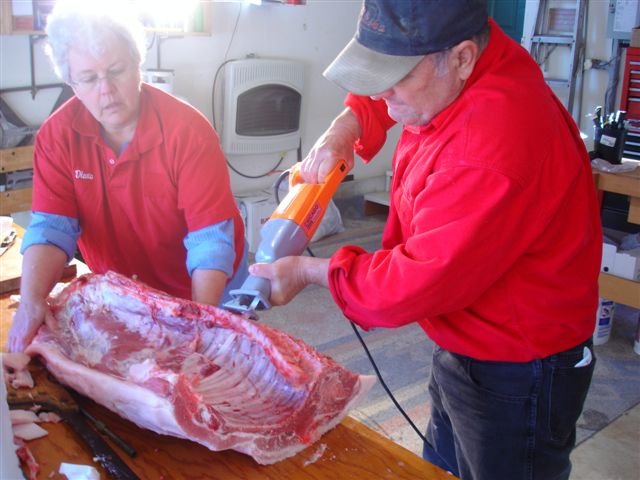
My dad is cutting the chine bone out with a twenty-dollar reticulating saw so that it'll be easier to separate the ribs into chops. My mom almost lost her arm at least twice. My folks don't always wear matching red shirts:

In the foreground are the ribs, which have been separated from the bacon and the part of the ribs you use for chops. My mom is trimming fat, I think. That's a big pile of it next to the lard pot:

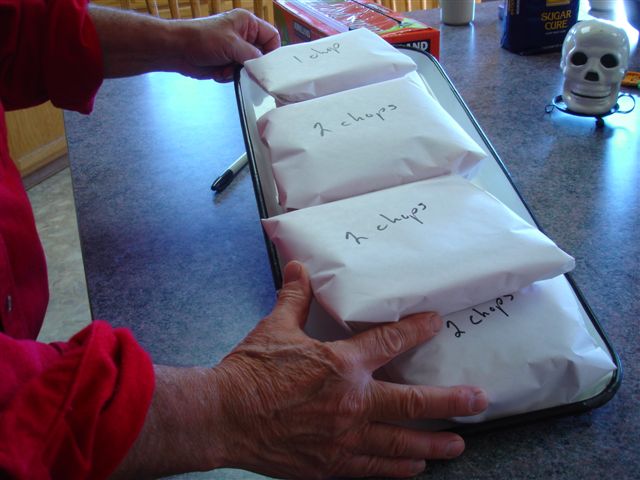
Chops ready for the freezer:


Sausage being made. The gray stuff off to the left is the liver, which Mom and Dad froze for later use in liverwurst. The white stuff is fat, of course, some of which went into the sausage and some of which was rendered for lard. The KitchenAid meat grinder/sausage stuffer attachment worked really well. It started to heat up at about pound twelve, but how often does a person want to make more than twelve pounds of sausage anyway?


This is andouille (salt, cracked pepper, garlic, cayenne, thyme), which Dad smoked the next day:

Breakfast of pann haas, fried in bacon fat. We made about ten loaves of it:

The hams were all that was left to take care of as it was getting light outside (we were all up with the bug at 3:30 that morning and just went ahead and started the job, so it was pretty much done by noon). After the bulk of the butchering was over, Dad put a fresh piece of cardboard underneath the hook just in case he got a deer that evening. In fact, he had one in his sights later, but decided to let it live. As he said, that deer was lucky we'd just butchered a whole hog.

Tuesday, November 07, 2006

He's a Pretty Clean Dog

Sorry: I still don't have hog pictures. But here are a few of the bug, who's been a sweet little terror the last few days. I'm betting we see a tooth before the week's out, as she's been making a funny face where she sucks her lips in and smacks them like an old lady, and she's been unusually fussy and unable to sleep well (the latter could have something to do with the fact that she stands up in her crib the second she's even partly awake, which makes it hard for her to fall back to sleep on her own and results in twenty-minute naps and frequent nighttime wakings).

We've been letting her crawl free as much as possible; the kitchen is relatively safe now, though she's always finding something we haven't thought of (a stack of newspapers on the window seat, a spilled coffee bean god help us), and there isn't much we can do about the garbage can she loves so dearly.

The other day I caught her sleeping on Wagner, and then, of course, she promptly woke up.